

Why Integration Is the New Standard for PEO Success
In the Professional Employer Organization (PEO) world, growth used to be mostly about adding more employer groups, expanding services, and building strong carrier relationships. Operations were complex, but manageable. Teams relied on spreadsheets, email, and a handful of systems, and for a long time, that worked.
But over the past few years, something has changed. PEOs are handling more data, more compliance requirements, more plan options, more underwriting interactions, and more reporting expectations than ever before. The issue is no longer whether PEOs have systems—it’s that most of those systems don’t talk to each other.
That’s why integration is quickly becoming the new standard for PEO success.
The Hidden Cost of Disconnected Systems
Most PEOs operate across multiple platforms:
Payroll systems
Benefits administration platforms
Census and eligibility data in spreadsheets
Underwriting submissions through email
Documents stored across shared drives
Renewal tracking in internal spreadsheets
Individually, each system serves a purpose. But operationally, the gaps between them create a lot of manual work.
These gaps usually show up as:
Re-entering the same census data in multiple places
Fixing formatting issues before underwriting submissions
Version control issues with census files
Manual plan comparisons
Last-minute reconciliation during renewals
Limited visibility into where each employer group stands
None of these are strategic problems, but they consume a significant amount of time and introduce risk into the process.
Where Teams Actually Spend Their Time
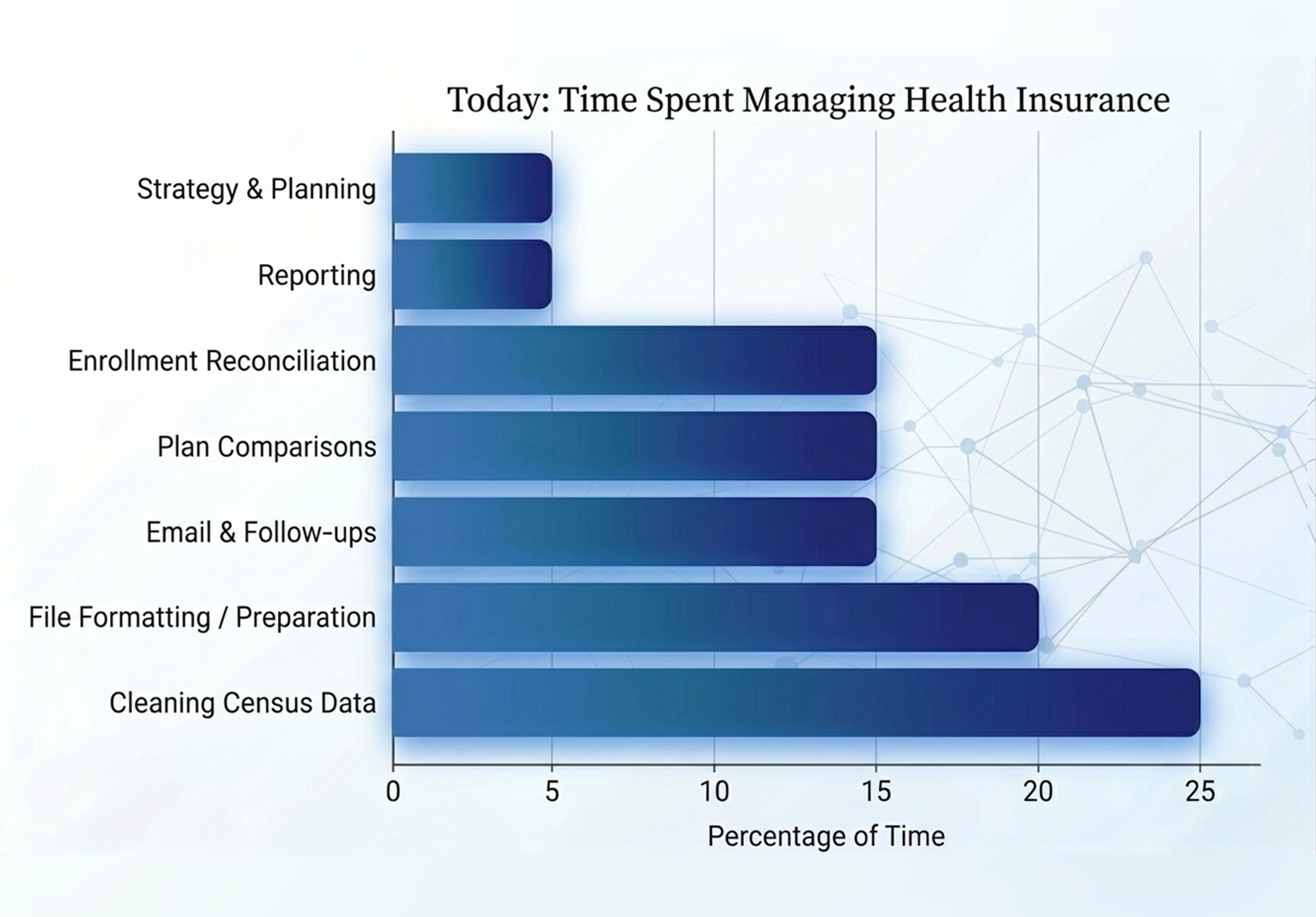
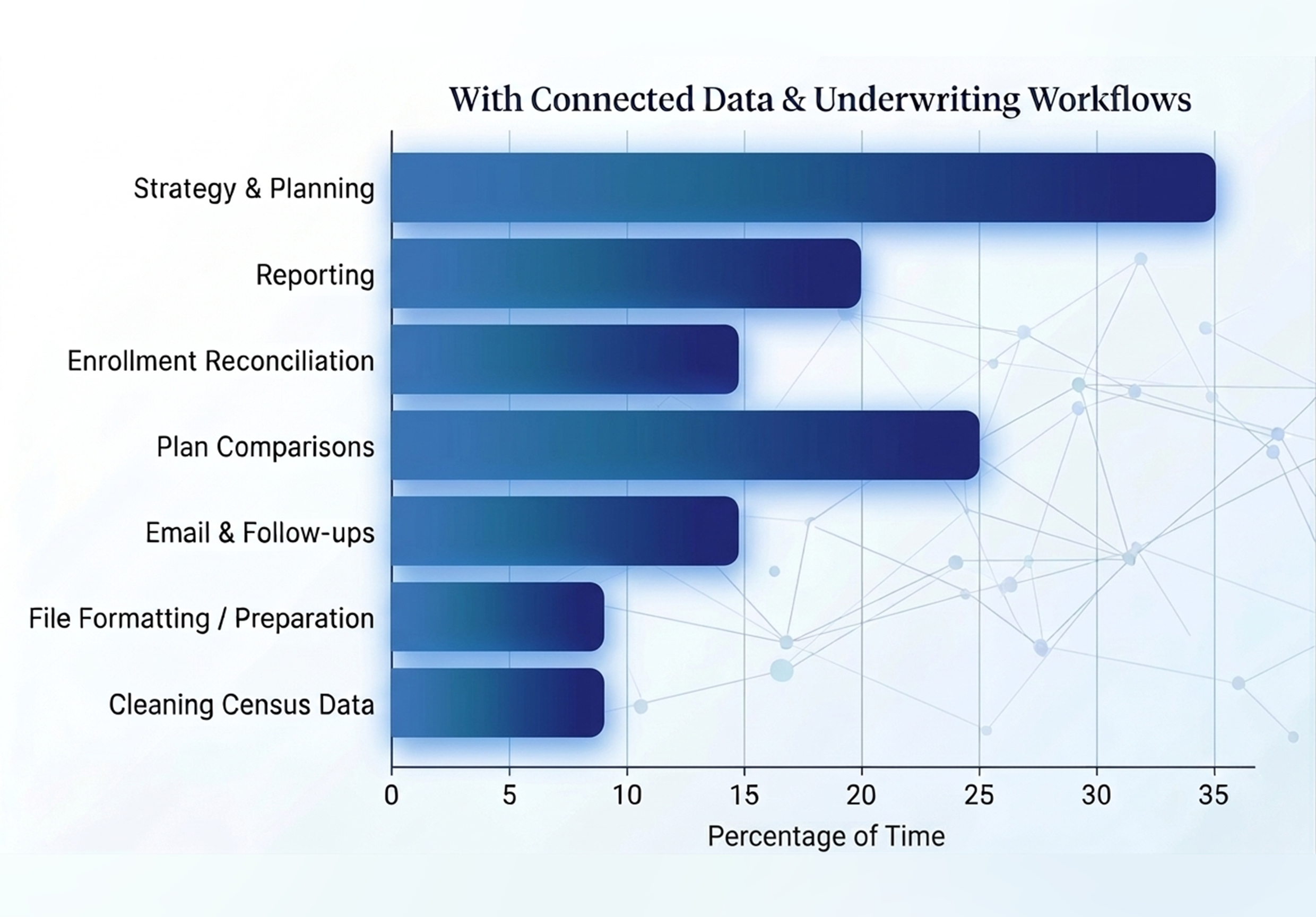
One of the biggest impacts of disconnected systems is not just slower workflows—it’s how teams spend their time.
Many PEO and underwriting teams expect their work to focus on evaluating plans, pricing strategy, client advisory, and managing renewals. In reality, a large portion of time is spent preparing data, fixing formatting issues, following up for missing information, and reconciling enrollment data across systems.
When workflows are disconnected, administrative data work expands and strategic work shrinks. When workflows are connected and data flows across systems, that balance shifts significantly.
Integration Is Not Just a Technology Upgrade
When people hear the word “integration,” they often think about APIs and software architecture. But for PEOs, integration is really about workflow continuity.
It means that data entered once should move through the entire lifecycle without needing to be recreated, reformatted, or rechecked at every step. In a more connected workflow:
Census data flows into underwriting without manual prep
Underwriting outputs feed directly into plan evaluation
Enrollment connects back to quoted data
Renewal workflows build on historical data
Teams don’t have to search across systems to understand status
Integration, in this context, is really about reducing friction across the lifecycle of a group.
Where Integration Matters Most for PEO Operations
If you look at a typical PEO workflow from submission to renewal, there are a few points where things consistently break down.
Census to Underwriting: Census data changes constantly due to new hires, terminations, and dependent updates. Without integration, teams spend time cleaning and restructuring data before it can even be submitted. With a connected workflow, data is validated and structured upfront, reducing errors and delays.
Underwriting to Plan Decisions: PEOs evaluate multiple plan options across carriers and funding strategies. When data is fragmented, plan comparisons happen across spreadsheets with inconsistent assumptions. Integration ensures decisions are based on the same, validated dataset.
Quoted Census to Final Enrollment: One of the biggest operational risks is mismatch. The population that was quoted often doesn’t match what actually enrolls. Without integration, reconciliation becomes manual and reactive. With integrated workflows, changes are tracked continuously and transparently.
Workflow Visibility: Managing multiple employer groups across different stages—submission, quoting, renewal, audit—becomes difficult without a unified view. Integration brings visibility into the entire pipeline so teams can act proactively instead of reactively.
Transparency doesn’t limit flexibility. In many cases, it enables it. Underwriters can apply thoughtful judgment knowing that the rationale behind decisions remains visible and explainable later.
Where DataHub Fits In for PEOs
This is where DataHub becomes relevant, not as another system to manage, but as the layer that connects the workflow PEOs already operate.
Instead of replacing payroll or benefits platforms, DataHub sits around the underwriting and data workflows that are typically the most fragmented. In practice, this looks like:
Census data comes in from multiple sources
DataHub standardizes and structures it automatically
Data gets validated before it moves forward
Underwriting submissions become easier to manage
Plan comparisons happen on the same dataset
Enrollment is continuously reconciled against quoted census
Workflows are visible across all employer groups
What this really does is connect the dots between steps that were previously handled in isolation.
The Competitive Advantage Is Shifting
In the past, PEOs competed primarily on relationships, pricing, and network access. Those still matter. But increasingly, operational capability is becoming the differentiator.
How quickly can you prepare and submit cases?
How accurately can you manage census data?
How efficiently can you evaluate plan options?
How well can you handle renewals at scale?
These are no longer just process questions.
They are integration questions.
Final Thoughts
Most PEO operational challenges don’t come from lack of expertise or effort. They come from systems that weren’t designed to work together. As complexity increases, that gap becomes harder to manage manually.
Integration changes that by connecting data, workflows, and decisions into a continuous system instead of disconnected steps. And that’s why, for PEOs looking to scale without adding operational strain, integration is no longer optional.
It’s the new standard.