

The 9% Problem: Why Group Health Underwriting Has the Worst Close Ratios in Insurance
Did you know that group health underwriting operates with one of the lowest close ratios in the entire insurance industry?
Most teams know this instinctively. They feel it every renewal season, every time quote volumes spike, every time the team is stretched thin. But very few stop to quantify what’s actually happening. Across the market, close ratios typically fall between 9% and 13%. Which means that close to 90% of all quotes never turn into revenue.
At first glance, that sounds like a sales inefficiency. But when you look closer, it reveals something much deeper. This isn’t just a conversion problem.It’s an operating model problem.

Why this isn’t a pricing problem
It’s easy to assume that low close ratios are a reflection of pricing competitiveness or broker relationships. But in group health, the reality is more structural than that.
When a broker takes a group to market, the case rarely goes to a single carrier. It’s typically shared across multiple carriers at the same time. Each carrier receives the same census, the same plan details, the same expectations. Each one does the work — reviewing data, building rates, preparing documentation — fully aware that only one will win. So even when underwriting is done well, most of that work is destined not to convert.
That dynamic has only intensified over time. Broker consolidation and more aggressive marketing cycles have increased how often groups are shopped. The number of opportunities hasn’t necessarily grown — but the number of carriers working each opportunity has.
At the same time, the work behind each quote has become heavier. What used to be a relatively straightforward pricing exercise now involves multiple funding arrangements, deeper claims analysis, and more variation in plan design. The effort required per quote has gone up, but the likelihood of winning hasn’t moved.
That imbalance is where the strain begins to show.
The real operational impact
The easiest way to understand the impact of a 9% close ratio is to think about what it demands from an underwriting team. If a team quotes 100 groups and wins around 10, it still had to fully process the other 90. Every one of those cases required time — reviewing census files, correcting data issues, building rate models, responding to broker questions, revising quotes, documenting decisions.
None of that work is optional. It’s required just to stay competitive in the market.
Over time, this creates a very specific kind of pressure. Underwriting teams are constantly active, constantly working through submissions, but a large portion of that effort never translates into written business.
And that starts to shift how the function operates. The constraint is no longer just underwriting expertise — it becomes capacity
Where underwriting time actually goes
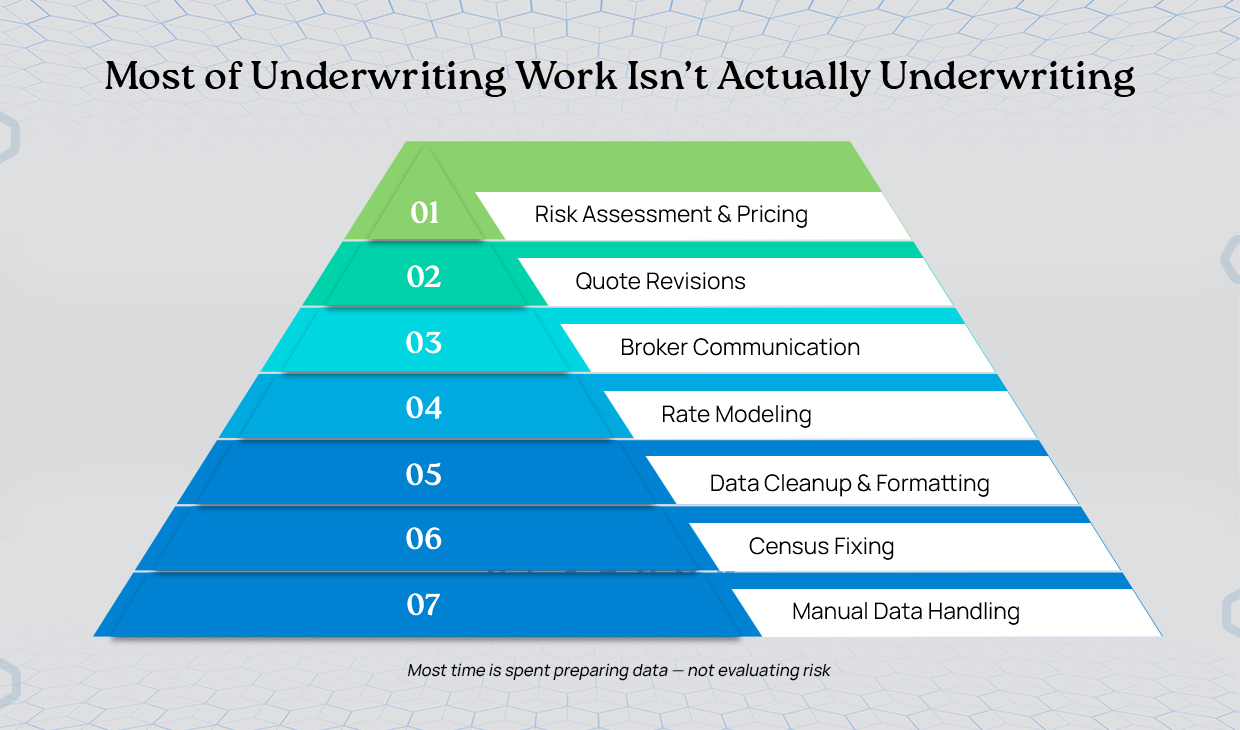
One of the more surprising realities inside underwriting teams is how little time is actually spent on underwriting itself. A significant portion of the day is taken up by everything around the quote — fixing census files, chasing missing information, reworking spreadsheets, adjusting models after plan changes, coordinating with brokers and internal teams.
Risk assessment is still critical, but it’s only one part of a much larger process. When you layer that onto already low close ratios, the issue becomes clearer. It’s not just that most quotes don’t convert. It’s that a large share of underwriting time is spent on activities that don’t directly contribute to decision-making.
That’s where inefficiency starts to compound.
Why is this becoming a competitive advantage issue
For a long time, underwriting advantage was defined by pricing accuracy and risk selection. Those factors still matter, but they’re no longer the only ones that determine outcomes. Speed is starting to play a much bigger role.
In a market where brokers are managing multiple quotes at once, responsiveness becomes part of the decision-making process. The carriers that get back quickly, handle revisions smoothly, and make it easier to work through a case tend to stay top of mind.
That doesn’t always show up immediately in close ratios. But over time, it influences who gets more opportunities to quote in the first place. And that’s where the shift happens. Workflow efficiency starts to influence growth.
Why incremental fixes don’t solve it
Most organizations recognize the pressure, and many try to address it. But the solutions often stay at the surface level. They add more underwriters to handle volume. They introduce new tools without changing how data flows into those tools. They continue to rely on spreadsheets because that’s where the work has always lived.
The result is usually the same: more capacity added, but the underlying friction remains. Because the issue isn’t just about tools or headcount. It’s about how underwriting work moves from submission to quote.
Rethinking the problem
The 9% close ratio isn’t something underwriting teams can control. It’s a function of how the market operates. What can change is how teams handle the workload that comes with it. The conversation is slowly shifting from “How do we win more quotes?” to something more fundamental:
How do we handle quote volume in a way that doesn’t overwhelm the team? That means looking at how data is received, how it’s processed, how much manual effort is involved, and how quickly a quote can realistically move from intake to output.
Because in this environment, reducing friction matters just as much as improving accuracy.
The bigger takeaway
The structure of the group health market isn’t going to change anytime soon. Close ratios will likely remain low, and competition will continue to increase. But not all underwriting teams will feel the impact the same way.
The ones that rethink how work gets done — not just how risk is priced — will be in a much stronger position. They’ll be able to respond faster, handle more volume, and stay consistent even during peak periods. And over time, that translates into something more meaningful than a marginal improvement in close ratio.
It translates into more opportunities, better broker relationships, and ultimately, more business. Because in group health underwriting, the real challenge isn’t the 9%. It’s everything that happens because of the other 91%.